
Safeguarding.
The Trustees of Falkirk Vineyard Church have adopted the following Safeguarding Policy and it is specific to the needs and contexts of our engagement with children, young people and vulnerable adults. They have delegated the day to day responsibility of enforcing the Policy to the Leadership (Senior Pastors Andrew and Lorraine McNinch). The Policy ensures we will continue to stay up to date with best practice and working safely with our community.
The policy and procedures have been divided into six sections.
Section 1.
DETAILS & DESCRIPTION OF THE CHURCH
Organisation Details
Name: Falkirk Vineyard Church
Address: 66 Union Rd, Camelon, Falkirk, FK1 4FP
Telephone: 07510 539534
Email: info@falkirkvineyard.com
Charity Number: SC045176
Insurance: Ansvar Church Fellowship Connect, Policy CHF6115333
1.2 Brief Description
Falkirk Vineyard Church (the church) is a Christian Church meeting regularly for services and other events. It is an independent organisation affiliated to Vineyard Churches UK & Ireland.
The Sunday services incorporate groups for young people aged 0-18 yrs. Most of the team who work with young people are volunteers. Not all the church events occur in the same building. Regardless of the location of the event this safeguarding policy will be applied.
1.3 Our Commitment
The Leadership recognise the need to provide a safe and caring environment for children, young people and vulnerable adults. We acknowledge that children, young people and vulnerable adults can be the victims of physical, sexual and emotional abuse, and neglect. We accept the UN Universal Declaration of Human Rights and the International Covenant of Human Rights, which states that everyone is entitled to "all the rights and freedoms set forth therein, without distinction of any kind, such as race, colour, sex, language, religion, political or other opinion, national or social origin, property, birth or other status".
We also concur with the Convention on the Rights of the Child which states that children should be able to develop their full potential, free from hunger and want, neglect and abuse. They have a right to be protected from "all forms of physical or mental violence, injury or abuse, neglect or negligent treatment or exploitation, including sexual abuse, while in the care of parent(s), legal guardian(s), or any other person who has care of the child." As a Leadership we have therefore adopted the procedures set out in this safeguarding policy in accordance with statutory guidance.
We are committed to build constructive links with statutory and voluntary agencies involved in safeguarding.
The Leadership undertakes to:
Endorse and follow all national and local safeguarding legislation and procedures, in addition to the international conventions outlined above (for instance, The Scottish Government's National Guidance for Child Protection in Scotland 2014 or the Forth Valley Inter-Agency Child Protection Guidance 2016).
Provide on-going safeguarding training for all its workers and will regularly review the operational guidelines attached.
Ensure that the premises meet the requirements of the Disability Discrimination Act 1995 and all other relevant legislation, and that it is welcoming and inclusive.
Support the Safeguarding Coordinator(s) in their work and in any action they may need to take in order to protect children and vulnerable adults.
Local Falkirk Council Social Work Department:
01324 506400 (M-F, 9am - 5pm)
or 01786 470500 (all other times)
Section 2.
RECOGNISING AND RESPONDING APPROPRIATELY TO AN ALLEGATION OR SUSPICION OF ABUSE
2.1 UNDERSTANDING ABUSE AND NEGLECT
Defining child abuse or abuse against a vulnerable adult is a difficult and complex issue. A person may abuse by inflicting harm or failing to prevent harm. Children and adults in need of protection may be abused within a family, an institution or a community setting. Very often the abuser is known or in a trusted relationship with the child or vulnerable adult.
In order to safeguard those in our places of worship and organisations we adhere to the UN Convention on the Rights of the Child and have as our starting point as a definition of abuse, Article 19 which states that:
1. States Parties shall take all appropriate legislative, administrative, social and educational measures to protect the child from all fonns of physical or mental violence, injury or abuse, neglect or negligent treatment, maltreatment or exploitation, including sexual abuse, while in the care of parent(s), legal guardian(s) or any other person who has the care of the child.
2. Such protective measures should, as appropriate, include effective procedures for the establishment of social programmes to provide necessary support for the child and for those who have the care of the child, as well as for other fonns of prevention and for identification, reporting, referral, investigation, treatment and follow-up of instances of child maltreatment described heretofore, and, as appropriate, for judicial involvement.
Also, for adults the UN Universal Declaration of Human Rights with particular reference to Article 5 which states:
No one shall be subjected to torture or to cruel, inhuman or degrading treatment or punishment.
Detailed definitions, and signs and symptoms of abuse, as well as how to respond to a disclosure of abuse, are included here in our policy.
2.2 DEFINITIONS OF ABUSE FOR CHILDREN
2.2.1 What is abuse and neglect?
Abuse and neglect are forms of maltreatment of a child. Somebody may abuse or neglect a child by inflicting harm, or by failing to act to prevent harm. Children may be abused in a family or in an institutional or community setting, by those known to them or, more rarely, by a stranger for example, via the internet. They may be abused by an adult or adults, or another child or children.
2.2.2 Physical abuse
Physical abuse is the causing of physical harm to a child or young person. Physical abuse may involve hitting, shaking, throwing, poisoning, burning or scalding, drowning or suffocating. Physical harm may also be caused when a parent or carer feigns the symptoms of, or deliberately causes, ill health to a child they are looking after.
2.2.3 Emotional abuse
Emotional abuse is persistent emotional neglect or ill treatment that has severe and persistent adverse effects on a child's emotional development. It may involve conveying to a child that they are worthless or unloved, inadequate or valued only insofar as they meet the needs of another person. It may involve the imposition of age -or developmentally -inappropriate expectations on a child. It may involve causing children to feel frightened or in danger, or exploiting or corrupting children. Some level of emotional abuse is present in all types of ill treatment of a child; it can also occur independently of other forms of abuse.
2.2.4 Sexual abuse
Sexual abuse is any act that involves the child ln any activity for the sexual gratification of another person, whether or not it is claimed that the child either consented or assented. Sexual abuse involves forcing or enticing a child to take part in sexual activities, whether or not the child is aware of what is happening. The activities may involve physical contact, including penetrative or non-penetrative acts. They may include non-contact activities, such as involving children in looking at, or in the production of indecent images or in watching sexual activities, using sexual language towards a child or encouraging children to behave in sexually inappropriate ways.
2.2.5 Neglect
Neglect is the persistent failure to meet a child's basic physical and/or psychological needs, likely to result in the serious impairment of the child's health or development. It may involve a parent or carer failing to provide adequate food, shelter and clothing, to protect a child from physical harm or danger, or to ensure access to appropriate medical care or treatment. It may also include neglect of, or failure to respond to, a child's basic emotional needs. Neglect may also result in the child being diagnosed as suffering from "non-organic failure to thrive", where they have significantly failed to reach normal weight and growth or development milestones and where physical and genetic reasons have been medically eliminated. In its extreme form children can be at serious risk from the effects of malnutrition, lack of nurturing and stimulation. This can lead to serious long-term effects such as greater susceptibility to serious childhood illnesses and reduction in potential stature. With young children in particular, the consequences may be lifethreatening within a relatively short period of time.
2.3 SIGNS AND SYMPTOMS OF ABUSE
The following signs could be indicators that abuse has taken place but should be considered in context of the child's whole life.
2.3.1 Physical Abuse
Injuries not consistent with the explanation given for them.
Injuries that occur in places not normally exposed to falls, rough games, etc.
Injuries that have not received medical attention.
Reluctance to change for, or participate in, games or swimming. Repeated urinary infections or unexplained tummy pains. Bruises on babies, bites, burns, fractures etc which do not have an accidental explanation* Cuts/scratches/substance abuse*
2.3.2 Sexual Abuse
Any allegations made concerning sexual abuse.
Excessive preoccupation with sexual matters and detailed knowledge of adult sexual behaviour.
Age-inappropriate sexual activity through words, play or drawing.
Child who is sexually provocative or seductive with adults.
Inappropriate bed-sharing arrangements at home.
Repeated urinary infections or unexplained tummy pains.
Severe sleep disturbances with fears, phobias, vivid dreams or nightmares, sometimes with overt or veiled sexual connotations. Eating disorders - anorexia, bulimia*
2.3.3 Emotional Abuse
Changes or regression in mood or behaviour, particularly where a child withdraws or becomes clinging.
Depression, aggression, extreme anxiety.
Nervousness, frozen watchfulness.
Obsessions or phobias.
Sudden under-achievement or lack of concentration.
Inappropriate relationships with peers and/or adults.
Attention-seeking behaviour.
Persistent tiredness.
Running away/stealing/lying
2.3.4 Neglect
Under nourishment, failure to grow, constant hunger, stealing or gorging food, Untreated illnesses, Inadequate care etc.
*These indicate the possibility that a child or young person is self-harming. Approximately 20,000 are treated in accident and emergency departments in the UK each year.
2.4 HOW TO RESPOND TO A CHILD WISHING TO DISCLOSE ABUSE
2.4.1 Effective Listening
• Ensure the physical environment is welcoming, giving opportunity for the child or vulnerable adult to talk in private but making sure others are aware the conversation is taking place.
• It is especially important to allow time and space for the person to talk.
• Above everything else listen without interrupting.
• Be attentive and look at them whilst they are speaking. • Show acceptance of what they say (however unlikely the story may sound) by reflecting back words or short phrases they have used.
• Try to remain calm, even if on the inside you are feeling something different.
• Be honest and don't make promises you can't keep regarding confidentiality.
• If they decide not to tell you after all, accept their decision but let them know that you are always ready to listen.
• Use language that is age appropriate and, for those with disabilities, ensure there is someone available who understands sign language, Braille etc.
2.4.2 Helpful Responses
• I believe you (or showing acceptance of what the child says).
• You have done the right thing in telling me.
• I'm glad you have told me.
• It's not your fault.
• I wilt help you.
2.4.3 Don't Say ...
• Why didn't you tell anyone before?
• I can't believe it!
• Are you sure this is true?
• Why? How? When? Who? Where?
• I am shocked, don't tell anyone else.
Don't make the child/young person repeat the story unnecessarily.
Do not ask probing questions or push for more information.
Don't promise to keep secrets but assure the child/young person that you will share only with someone who can help.
2.5 DEFINITIONS OF ABUSE FOR VULNERABLE ADULTS
2.5.1 Introduction
The following definition of abuse is laid down in 'No Secrets: Guidance on developing and implementing multi-agency policies and procedures to protect vulnerable adults from abuse (Department of Health 2000):
'Abuse is a violation of an individual's human and civil rights by any other person or persons. In giving substance to that statement, however, consideration needs to be given to a number of factors:
Abuse may consist of a single act or repeated acts. It may be physical, verbal or psychological, it may be an act of neglect or an omission to act, or it may occur when a vulnerable person is persuaded to enter into a financial or sexual transaction to which he or she has not consented or cannot consent. Abuse can occur in any relationship and may result In significant harm to, or exploitation of, the person subjected to it'.
2.5.2 Physical Abuse
This is the infliction of pain or physical injury, which is either caused deliberately, or through lack of care.
2.5.3 Sexual Abuse
This is the involvement in sexual activities to which the person has not consented or does not truly comprehend and so cannot give informed consent, or where the other party is in a position of trust, power or authority and uses this to override or overcome lack of consent.
2.5.4 Psychological or Emotional Abuse
These are acts or behaviour, which cause mental distress or anguish or negates the wishes of the vulnerable adult. It is also behaviour that has a harmful effect on the vulnerable adult's emotional health and development or any other form of mental cruelty.
2.5.5 Financial or Material Abuse
This is the inappropriate use, misappropriation, embezzlement or theft of money, property or possessions.
2.5.6 Neglect or Act of Omission
This is the repeated deprivation of assistance that the vulnerable adult needs for important activities of daily living, including the failure to intervene in behaviour which is dangerous to the vulnerable adult or to others. A vulnerable person may be suffering from neglect when their general well-being or development is impaired.
2.5.7 Discriminatory Abuse
This is the inappropriate treatment of a vulnerable adult because of their age, gender, race, religion, cultural background, sexuality, disability etc. Discriminatory abuse exists when values, beliefs or culture result in a misuse of power that denies opportunity to some groups or individuals. Discriminatory abuse links to all other forms of abuse.
2.5.8 Institutional Abuse
This is the mistreatment or abuse of a vulnerable adult by a regime or individuals within an institution (e.g. hospital or care home) or in the community. It can be through repeated acts of poor or inadequate care and neglect or poor professional practice.
2.6 SAFEGUARDING AWARENESS
The Leadership is committed to on-going safeguarding training and development opportunities for all workers, developing a culture of awareness of safeguarding issues to help protect everyone. All our workers will receive induction training from Safeguarding co-ordinators on basic procedures and will also be asked to read the safeguarding policy and sign to confirm they have read and understood it. All workers will be asked to do a refresher training course every three years.
2.7 RESPONDING TO ALLEGATIONS OF ABUSE (Children & Vulnerable Adults)
Under no circumstances should a worker carry out their own investigation into an allegation or suspicion of abuse. All allegations or suspicions of abuse should be reported to the appropriate person (see below) who will then follow the detailed procedures outlined in the next section:
2.7.1 Safeguarding Co-ordinator
The person in receipt of allegations or suspicions of abuse should report concerns as soon as possible to Lyndsey Henderson (hereafter the "Safeguarding Coordinator") who is nominated by the Leadership to act on their behalf in dealing with the allegation or suspicion of neglect or abuse, including referring the matter on to the statutory authorities. Where required the Safeguarding Coordinator should then immediately inform the Trustees Of Falkirk Vineyard who will notify Falkirk Vineyard Church's Insurance Company.
2.7.2 Deputy Safeguarding Co-ordinator
In the absence of the Safeguarding Co-ordinator or, if the suspicions or incident in any way involve the Safeguarding Co-ordinator, or any member of the Safeguarding officer’s family then the report should be made to Victoria Dube (hereafter the "Deputy").
2.7.3 Vulnerable Adults Safeguarding Co-ordinator
Where there is a concern about a vulnerable adult, the person in receipt of allegations or suspicions of abuse should report concerns as soon as possible to Lyndsey Henderson.
2.7.4 Falkirk Council Social Work
If the suspicions implicate both the Safeguarding Co-ordinator and the Deputy, then the report should be made in the first instance to Falkirk Council Social Work 01324 506400. Alternatively contact the police.
2.7.5 Procedures for reporting suspicions
Suspicions must not be discussed with anyone other than the Safeguarding Co-ordinator/Deputy. The role of the Safeguarding Co-ordinator/Deputy is to collate and clarity the precise details of the allegation or suspicion and pass this information on to statutory agencies who have a legal duty to investigate.
Whilst allegations or suspicions of abuse will normally be reported to the Safeguarding Coordinator, the absence of the Safeguarding Co-ordinator or Deputy should not delay referral to Social Services, the Police and taking advice from the National Society for the Prevention of Cruelty to Children (NSPCC) 0808 800 5000.
2.7.6 Retention of records
A written record of concerns should be made in accordance with these procedures (2.7.5). Records should always be stored in individual files in a separate locked cabinet on Church premises. Records relating to child protection wil be kept for 18 years after Falkirk Vineyard Church's last contact with the child and their family, even if concerns were not reported.
2.7.7 Sharing Information on a 'Need to Know' Basis
It is important for the Safeguarding Co-ordinator / Deputy to maintain confidentiality, sharing sensitive and personal information only on a 'need to know' basis. At Falkirk Vineyard Church, such people would ordinarily include:
• the church Safeguarding Coordinator/Deputy
• the statutory agencies to whom a safeguarding referral is being made (such as Children's or Adult Services, the police or others).
• the Senior Pastors.
The Safeguarding Trustee will be informed that a safeguarding case is being dealt with and the actions being taken, without divulging confidential details of the case, such as the people involved or the precise nature of the issue.
2.7.8 Direct Reporting
It is, of course, the right of any individual as a citizen to make a direct referral to the safeguarding agencies or seek advice from SPCC, although the Leadership hope that members of Falkirk Vineyard Church will use this procedure. If, however, the individual with the concern feels that the Safeguarding Co-ordinator/Deputy has not responded appropriately, or where they have a disagreement with the Safeguarding Co-ordinator/Deputy as to the appropriateness of a referral they are free to contact an outside agency directly. We hope by making this statement that the Leadership demonstrates its commitment to effective safeguarding and the protection of all those who are vulnerable.
2.8 DETAILED PROCEDURES WHERE THERE IS A CONCERN ABOUT A CHILD
2.8.1 Allegations of Physical Injury, Neglect or Emotional Abuse
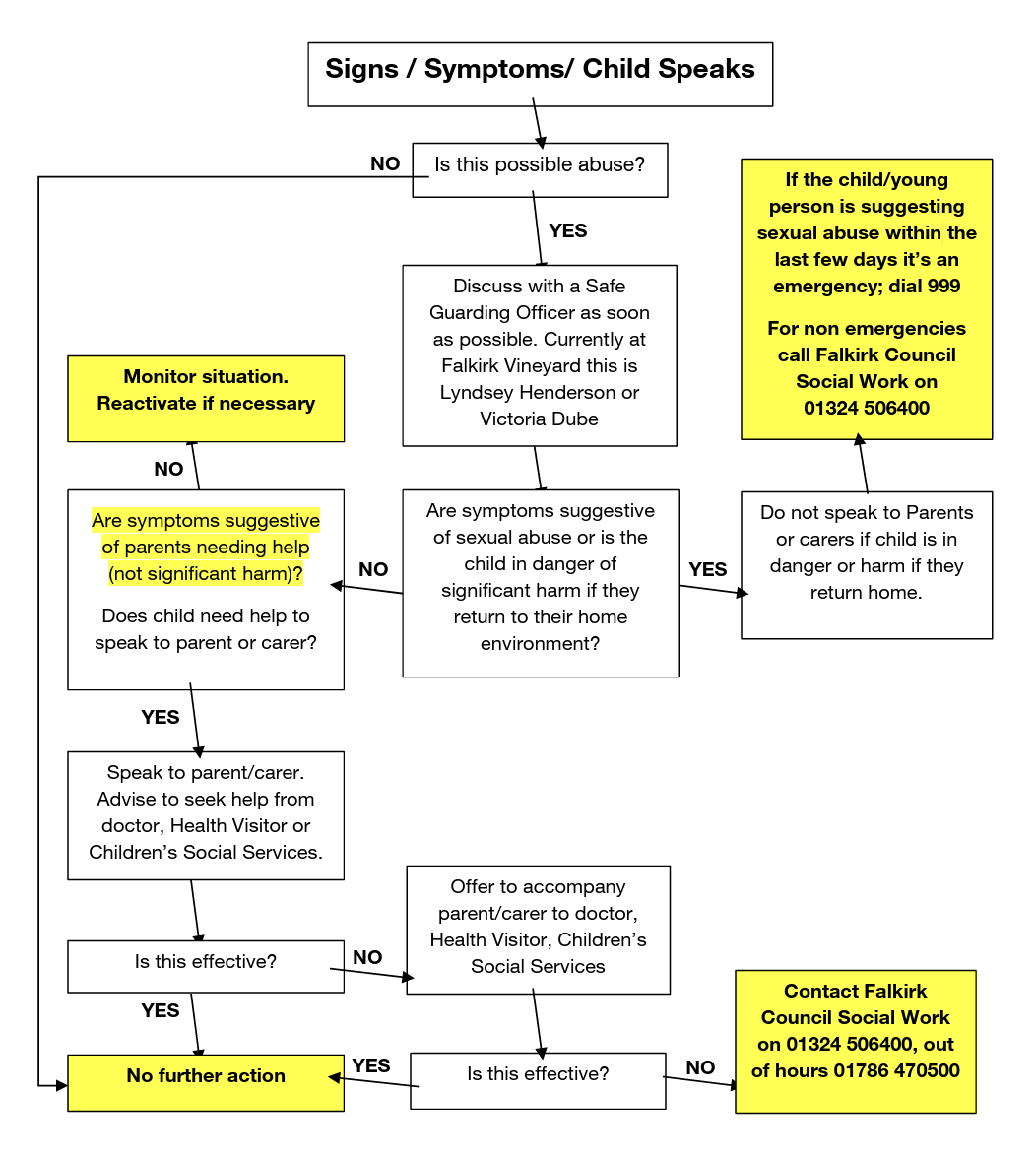
If a child has a physical injury, a symptom of neglect or where there are concerns about emotional abuse, the Safeguarding Co-ordinator/Deputy will:
• Contact the Falkirk Council Social Work for advice in cases of deliberate injury, if concerned about a child's safety or if a child is afraid to return home.
• NOT tell the parents or carers unless advised to do so, having contacted Falkirk Council Social Work.
• Seek medical help if needed urgently, informing the doctor of any suspicions.
• For lesser concerns, encourage parent/carer to seek help, but not if this places the child at risk of significant harm.
• Where the parent/carer is unwilling to seek help, offer to accompany them. In cases of real concern, if they still fail to act, contact Children and Young People's Social Care direct for advice.
• Seek and follow advice given by NSPCC if unsure whether or not to refer a case to Falkirk Council Social Work.
2.8.2 Allegations of Sexual Abuse,
and/or Significant Harm
In the event of allegations or suspicions of sexual abuse and/or significant harm, the Safeguarding Co-ordinator/Deputy will:
• Contact Falkirk Council Social Work or the Police Child Protection Team directly. They will NOT speak to the parent/carer or anyone else.
• Seek and follow the advice given by NSPCC if, for any reason, they are unsure whether or not to contact Falkirk Council Social Work/Police.
2.8.3 Flowchart | Responding to an Allegation of Abuse
2.9 DETAILED PROCEDURES WHERE THERE IS A CONCERN ABOUT AN ADULT IN NEED OF PROTECTION
2.9. 1 Suspicions or Allegations of Physical or Sexual Abuse
If a vulnerable adult has a physical injury or symptom of physical or sexual abuse the Safeguarding Co-ordinator/Deputy will:
• Discuss any concerns with the individual themselves giving due regard to their autonomy, privacy and rights to lead an independent life.
• If the vulnerable adult is in immediate danger or has sustained a serious injury contact the Emergency Services, informing them of any suspicions.
• For advice contact the Falkirk Council Adult Support & Protection Team on 01324 506400 or 01786 470500 (out of hours) who have responsibility under Section 4 of the Adult Support and Protection (Scotland) Act 2007 and the 'Act Against Harm' Scottish Government guidance to investigate allegations of abuse.
2.10 ALLEGATIONS OF ABUSE AGAINST A PERSON WHO WORKS WITH CHILDREN
If an accusation is made against a worker (whether a volunteer or paid member of staff) whilst following the procedure outlined above, the Safeguarding Co-ordinator / Deputy, in accordance with Forth Valley Inter-Agency Child Protection Guidance procedures will need to liaise with the Falkirk Child Protection Committee to determine whether a multi-agency planning meeting and subsequent investigation is required. Suspension of the worker pending investigation will be determined by a risk assessment, the nature of the allegations made, and the safety of children using the service.
Section 3.
PREVENTION
3.1 Safe Recruitment
The Leadership will ensure all workers will be appointed, trained, supported and supervised in accordance with government guidance on safe recruitment. This includes ensuring that:
Those applying have completed an Application & Self Declaration Form
Potential recruits have been interviewed (informally with a chat)
Safeguarding has been discussed at interview
Written references have been obtained, and followed up where appropriate
A Protecting Vulnerable Groups (PVG) check has been completed (we will comply with Code of Practice requirements concerning the fair treatment of applicants and the handling of information)
Induction and appropriate training are provided
The applicant has completed a 3-month probationary period
The applicant has been given a copy of the organisation's safeguarding policy and knows how to report concerns.
3.2 Children/Youth Team Recruiting Process
The following staged process will take place:
Stage 1. A potential Children or Youth volunteer is identified and referred to the team leader
Stage 2. Children / Youth Pastor conducts brief interview with candidate & gives them a SAFEGUARDING PACK consisting of: Safeguarding Policy to read; Application & Self Declaration Form to complete; PVG Form to complete.
Stage 3. Applicant receives a Safeguarding Interview where they hand in their completed forms (Application & Self Declaration, PVG). Their identity documents are checked and they sign to acknowledge they have read & understood the Safeguarding Policy.
Stage 4. On receipt of their PVG certificate and satisfactory references, and in liaison with the Children/Youth team leaders, the applicant can begin their 3 month probationary period. On completion of their probation, they will become a full team member. If there are any grounds for concern, these will be discussed fully with the applicant and an appropriate course of action decided upon.
3.3 Management of Workers
The Leadership are committed to supporting all workers and ensuring they receive support and supervision. All workers will be issued with this Safeguarding Policy and a Team Member's Handbook which details our expectations of conduct towards children. The Leadership undertakes to follow the principles found within the 'Abuse Of Trust 'guidance issued by the Home Office and it is therefore unacceptable for those in a position of trust to engage in any behaviour which might allow a sexual relationship to develop for as long as the relationship of trust continues. (See Section 5)
Section 4.
PASTORAL CARE
4.1 Supporting those affected by abuse
The Leadership is committed to offering pastoral care, working with statutory agencies as appropriate, and support to al those who have been affected by abuse who have contact with or are part of the church. This will be through pastoral visits, prayer ministry teams and referrals to external agencies where appropriate.
4.2 Working with offenders
When someone attending the church is known to have abused children or is known to be a risk to vulnerable adults the Leadership will supervise the individual concerned and offer pastoral care, but in its safeguarding commitment to the protection of children and vulnerable adults, set boundaries for that person which they will be expected to keep. This would take the form of a contract giving details of both the boundaries which the individual is expected to keep and the support they will be offered by the church. It will be tailored specifically to individual circumstances and informed ideally by risk assessments from the statutory agencies.
Section 5.
PRACTICE GUIDELINES
5.1 Introduction to Practice Guidelines
As a church working with children, young people and vulnerable adults we wish to operate and promote good working practice. This will enable workers to run activities safely, develop good relationships and minimise the risk of false accusation.
5.2 Principles of Good Working Practice
All volunteer workers are strongly advised to adhere to these principles of good working practice outlined below wherever possible:
1. Treat ALL children/young people with warmth, respect and dignity relevant to their age.
2. Be aware of your own language style, voice tone, and body language and how the individual child/young person might perceive this.
3. Ensure that you are never alone with a child where your activity cannot be seen. This may mean leaving doors open, or two groups working in the same room.
4. Keep all physical contact public e.g. hugs.
5. Touch should be related to the child's needs, not the worker's.
6. Touch should be age-appropriate and generally initiated by the child rather than the worker. (N.B. In the case of babies, they will initiate the need for a cuddle, usually by crying)
7. Team members should support one another in the area of physical contact. They should be free to help each other by pointing out anything that could be misconstrued.
8. In a counselling situation with a young person over the age of 11, where privacy and confidentiality are important, make sure that there are two workers of the same sex present. Leave doors open where possible.
9. Under no circumstances should physical punishment be used.
10. Where a child requires the toilet the following should apply:
• Nappies will not be changed by workers - only by the child's parent or carer.
• Children who require the toilet will have their parent/guardian notified to assist them.
• Children attending our youth events (High school age) will be accompanied by a worker of the same sex who will stand outside the toilet to ensure their safety.
11. Always ensure parent or carer is contacted and present where removal of a child's clothing is essential (e.g. soiling of clothes - or a medical accident).
12. Children's groups should be staffed according to the following widely recognised minimum ratios of adults* to children:
Age 0 - under 2 yrs : 1 adult to 3 children
Age 2 - under 3 yrs : 1 adult to 5 children
Age 3 - under 8 yrs: 1 adult to 8 children**
Over 8 yrs : 1 adult to 10 children
Outings (under 6s) : 2:4.
Outings (6-16) : 2:12 (mixed, if club mixed).
*Any volunteers under 18yrs do not count towards these ratios.
**Where children aged three and over attend settings for less than a continuous period of four hours in any one day the adult to child ratio can be one adult to 10 children.
13. No person under 18 years of age should be left solely in charge of any children of any age.
14. If anyone under 18 years of age is serving on a team at church they must not be left serving one to one with an adult in an enclosed space. They should always be serving with 2 or more adults from different households
15. Children or young people attending a group should not be left alone at any time.
16. Mobile Phones should not be used for personal calls or taking photos during sessions. Calls concerning emergency matters arising in activity time can be made to Pastoral staff. Photographs should be taken on a designated device and only be taken of children for whom you have permission to photograph. We ask that no photographs or images of children in our care are posted on any official church social media sites or personal social media site on behalf of the church when taken in your capacity as kids or youth worker/leader.
17. Any internet use during a session should be safe, appropriate and closely monitored.
18. All online group communication at Falkirk Vineyard will take place through the Jovo app. This will be checked every three weeks by either Lyndsey Henderson, Joanna Orr or Victoria Dube to ensure that messages remain appropriate. Owners of a chat should adhere to the guidelines given to them (see Appendix 2) and should report a concern to the Safeguarding team immediately.
19. No person under 16 years of age should be added to a church Jovo group until parent consent has been given.
20. Serious concerns about a colleague's behaviour should always be reported to the Safeguarding Co-ordinator/Deputy (see Section 2 for details).
5.3 Behaviour to Avoid
Workers should NOT engage in any of the following behaviour:
Participation in physical or sexually provocative games, however "innocent" they may appear.
2. Inappropriate or intrusive touching of any form.
3. Intimidating, ridiculing, belittling or apparent rejecting of a child or young person.
4. Making racist or sexist remarks of any kind.
5. Showing favouritism to any child or young person.
6. Invading the privacy of children either toileting, changing, washing or showering.
7. Making sexually suggestive remarks to or about young people - even in "fun" Is absolutely unacceptable.
8. Allowing young people to develop excessive attention seeking behaviour - especially if it is of a sexual or physical nature.
5.4 Additional Activities
Where additional activities, trips or socials are organised for the children/young people, the Kids and Families Pastor or Youth Pastor should arrange adequate supervision for those attending. It is recommended that when planning and undertaking additional activities the following guidelines should be followed:
1. A risk assessment is completed for each activity.
2. Young People up to the age of 18 must have a completed parent consent form before being allowed to attend a trip.
3. When planning residential holidays, workers (i.e. those over 18) should not sleep in the same room as children/young people.
4. Workers should be aware of the potential dangers involved when meeting with young people in a one on one situation at home or on trips. They should consider taking steps to avoid such dangers i.e. meeting in a public place, informing others of the meeting, leaving the door to a room open if appropriate.
5. When transporting children, workers should try to avoid being left alone with one child in the car. If this is unavoidable ask the child to sit in the back.
6. If a vulnerable adult requires a lift to or from church or for any other additional social events, then two responsible adults must be present in the vehicle and they should not be members of the same family or household as each other.
5.5 Working in Partnership
The diversity of organisations and settings means there can be great variation in practice when it comes to safeguarding children, young people and vulnerable adults. This can be because of cultural tradition, belief and religious practice or understanding, for example, of what constitutes abuse.
We therefore have clear guidelines in regards to our expectations of those with whom we work in partnership, whether in the UK or not. We will discuss with all partners our safeguarding expectations and have a partnership agreement for safeguarding.
Section 6.
STATEMENT OF COMMITMENT
Good communication is essential in promoting safeguarding, both to those we wish to protect, to everyone involved in working with children and vulnerable adults and to all those with whom we work in partnership. This safeguarding policy is just one means of promoting safeguarding. Our commitment to safeguarding will be displayed publicly on our website.
We will review our policy and procedures annually.
If you have any concerns for a child or vulnerable adult then speak to one of the following who have been approved as safeguarding co-ordinators for Falkirk Vineyard Church.
Lyndsey Henderson - Safeguarding Coordinator
Victoria Dube - Deputy Safeguarding Coordinator
Joanna Orr- Safeguarding Trustee
Appendix 1
LEADERSHIP SAFEGUARDING STATEMENT
The Leadership, recognise the importance of its ministry/work with children and young people and adults in need of protection and its responsibility to protect everyone entrusted to our care.
The following statement was agreed by the Leadership/Trustees on 12/01/2026
Falkirk Vineyard Church is committed to the safeguarding of children and vulnerable adults and ensuring their well-being, Specifically:
• We recognise that we all have a responsibility to help prevent the physical, sexual, emotional abuse and neglect of children and young people (those under 18 years of age) and to report any such abuse that we discover or suspect.
• We believe every child should be valued, safe and happy. We want to make sure that children we have contact with know this and are empowered to tell us if they are suffering harm.
• All children and young people have the right to be treated with respect, to be listened to and to be protected from all forms of abuse.
• We recognise that we all have a responsibility to help prevent the physical, sexual, psychological, financial and discriminatory abuse and neglect of vulnerable adults and to report any such abuse that we discover or suspect.
• We recognise the personal dignity and rights of vulnerable adults and will ensure all our policies and procedures reflect this.
• We undertake to exercise proper care in the appointment and selection of all those who will work with children and vulnerable adults.
We are committed to:
• Following the requirements for UK and Scottish legislation in relation to safeguarding children and vulnerable adults and good practice recommendations.
• Respecting the rights of children as described in the UN Convention on the Rights of the child.
• Implementing the requirements of legislation with regard to people with disabilities.
• Ensuring that workers adhere to the agreed procedures of our safeguarding policy.
• Keeping up to date with national and local developments relating to safeguarding.
• Following any denominational or organisational guidelines in relation to safeguarding children and adults in need of protection.
• Supporting the safeguarding co-ordinator/s in their work and in any action they may need to take in order to protect children/vulnerable adults.
• Ensuring that everyone agrees to abide by these recommendations and the guidelines established by this place of worship/organisation.
• Supporting parents, carers, adoptive/foster parents and families.
• Nurturing, protecting and safeguarding of children and young people.
• Supporting, resourcing, training, monitoring and providing supervision to all those who undertake this work.
• Supporting all in Falkirk Vineyard Church affected by abuse.
We recognise:
• Children's Social Services (or equivalent) has lead responsibility for investigating all allegations or suspicions of abuse where there are concerns about a child. Adult Social Care (or equivalent) has lead responsibility for investigating all allegations or suspicions of abuse where there are concerns about a vulnerable adult.
• Where an allegation suggests that a criminal offence may have been committed then the police will be contacted as a matter of urgency.
• Where working outside of the UK, concerns will be reported to the appropriate agencies in the country in which we operate, and their procedures followed, and in addition we will report concerns to our agency's headquarters.
• Safeguarding is everyone's responsibility.
Download the safeguarding PDF to see signatures on the agreement:
Appendix 2
RESPONSIBILITIES OF A JOVO CHAT OWNER
· You should include only relevant individuals within your chat by ensuring that the member list is up to date and reflects who serves on the team at that time.
· If you need to add a member who is under 16 years of age please check with a member of the Safeguarding team to ensure that they have been given parental consent to use the app before adding them.
· As a Jovo chat owner you will be aware of and adhere to our safeguarding policy (see above).
· You should ensure that all communication in the chat is appropriate and upholds Falkirk Vineyard’s vision and values at all times.
· I understand that my chats can be monitored and viewed by the Safeguarding Officers.
· Please let a member of the Safeguarding team know if you have had to delete a comment because you deem it inappropriate.
· You should notify a member of the Safeguarding team if any concerns arise when using Jovo.